We’ve all been there: spending six hours reading a 300-page time management book, only to emerge with a highlight reel of inspirational quotes and zero change to our actual schedule. The irony is brutal. You’re trying to save time, yet the very act of learning how becomes another time sink. The market is flooded with productivity manuals promising revolutionary transformations, but most deliver temporary motivation disguised as permanent solutions. The real question isn’t which book is “best”—it’s which book will actually save you more time than it costs.
The truth is that effective time management books aren’t about perfect systems or life hacks. They’re about finding a mental model that clicks with your specific chaos. Whether you’re drowning in back-to-back meetings, juggling client work with creative projects, or simply trying to find space for deep thinking amidst digital noise, the right framework acts like a lever—small input, massive output. But finding that lever requires knowing what to look for beyond Amazon reviews and bestseller lists. Let’s break down how to identify the books that genuinely return your investment with interest.
Top 10 Time Management Books
Detailed Product Reviews
1. Four Thousand Weeks

Overview: Oliver Burkeman’s “Four Thousand Weeks” offers a profound philosophical reframe of time management by confronting a stark truth: the average human lifespan is about 4,000 weeks. Rather than offering another optimization hack, this book challenges readers to embrace their finite existence and make peace with impossible choices. It’s aimed at productivity-weary individuals seeking meaning over mere efficiency.
What Makes It Stand Out: This book distinguishes itself by rejecting the cult of productivity entirely. Burkeman argues that accepting limitation is the real key to fulfillment. His counterintuitive approach draws from philosophy, psychology, and history to argue that doing less—and accepting you’ll never do it all—creates a more meaningful life than any productivity system could offer.
Value for Money: At $10.01, this paperback delivers exceptional value for a paradigm-shifting perspective that could fundamentally change your relationship with time. Compared to endless $15-20 productivity manuals promising life transformation, this offers deeper, more lasting insight for less.
Strengths and Weaknesses:
- Strengths: Beautifully written and deeply researched; provides genuine psychological relief; challenges harmful productivity narratives; offers intellectual substance over quick fixes.
- Weaknesses: Lacks concrete, actionable steps; can feel fatalistic to readers wanting solutions; philosophical approach may frustrate those seeking practical tools.
Bottom Line: If you’re exhausted by productivity culture and ready for a philosophical reset, this book is essential. It’s less a manual and more a companion for rethinking your entire approach to living. Highly recommended for the introspective reader.
2. ADHD Time Management Toolkit For Adults: 13 Exercises With Step-by-step Strategies To Plan Your Day, Stay Focused, And Get More Done Even When You Feel Scattered And Overwhelmed

Overview: This specialized workbook directly addresses the unique time management challenges faced by adults with ADHD. It provides 13 structured exercises with step-by-step strategies designed for neurodivergent brains that struggle with executive function. The approach acknowledges that conventional productivity systems often fail those who feel chronically scattered and overwhelmed.
What Makes It Stand Out: Unlike generic productivity books, this toolkit is specifically engineered for ADHD cognition. It breaks tasks into manageable chunks, incorporates body doubling concepts, and provides external accountability structures. The exercises focus on working with your brain rather than against it, making it a rare resource that validates ADHD experiences while offering practical solutions.
Value for Money: Priced at $13.99, this workbook offers solid value for its specialized focus. While more expensive than some general productivity books, its ADHD-specific strategies are worth the premium if you’ve struggled with traditional methods. Comparable coaching sessions would cost hundreds of dollars.
Strengths and Weaknesses:
- Strengths: Tailored specifically for ADHD challenges; highly actionable with clear exercises; addresses emotional aspects of time blindness; provides immediate implementation tools.
- Weaknesses: Content won’t resonate with neurotypical readers; exercises may feel repetitive; lacks depth for those already familiar with ADHD strategies; spiral binding would improve usability.
Bottom Line: If you’re an adult with ADHD who’s tired of one-size-fits-all productivity advice, this toolkit is a worthwhile investment. It’s practical, empathetic, and designed for your specific neurological needs. A game-changer for the target audience.
3. Getting Things Done: The Art of Stress-Free Productivity

Overview: David Allen’s “Getting Things Done” (GTD) is the foundational text of modern productivity methodology. This book introduces a comprehensive system for capturing all your commitments, clarifying next actions, and organizing them into a trusted external system. The goal is achieving a “mind like water” state where nothing falls through the cracks and mental stress is dramatically reduced.
What Makes It Stand Out: GTD’s universal capture principle revolutionized how people think about task management. Allen’s methodology is complete and systematic, offering specific workflows for processing everything from emails to life goals. The two-minute rule and next-action thinking have become ubiquitous because they work across contexts, making this a complete productivity operating system rather than a collection of tips.
Value for Money: At just $8.09, this influential classic is an absolute bargain. You’re getting access to a methodology that has spawned countless apps, courses, and careers for less than the cost of a lunch. The ROI on implementing even a fraction of Allen’s system far exceeds the purchase price.
Strengths and Weaknesses:
- Strengths: Proven, comprehensive system; reduces cognitive load significantly; adaptable to any tools; provides immediate stress relief when implemented; timeless principles.
- Weaknesses: Initial setup is time-intensive and overwhelming; requires consistent maintenance; examples feel dated; can become a productivity hobby unto itself.
Bottom Line: For anyone serious about productivity, this is required reading. While implementation takes effort, the GTD methodology remains the gold standard. Start with the basics and expand gradually. Essential for knowledge workers drowning in commitments.
4. Buy Back Your Time: Get Unstuck, Reclaim Your Freedom, and Build Your Empire

Overview: Dan Martell’s “Buy Back Your Time” targets entrepreneurs trapped in their own businesses. The book presents a framework for systematically delegating tasks to reclaim personal freedom while scaling your company. Martell introduces the “Buyback Loop”—a process for auditing, transferring, and filling tasks—to help business owners stop being the bottleneck in their own growth.
What Makes It Stand Out: This book’s singular focus on the entrepreneurial time-for-money trap sets it apart. Martell doesn’t just tell you to delegate; he provides a calculated approach to determining your “hourly rate” and outsourcing anything below that threshold. His emphasis on building systems that free you rather than chains you to your business offers a refreshing, ROI-driven perspective on time management.
Value for Money: At $15.99, this is the priciest option but delivers targeted value for entrepreneurs. If you’re a business owner billing $100+/hour, the book pays for itself by helping you delegate just one hour of work. For employees, the value proposition is weaker.
Strengths and Weaknesses:
- Strengths: Perfectly tailored for entrepreneurs; provides concrete delegation frameworks; includes scripts and templates; focuses on financial ROI of time; addresses psychological barriers to letting go.
- Weaknesses: Irrelevant for non-business owners; assumes you have revenue to invest in delegation; can feel transactional; less useful for solopreneurs on tight budgets.
Bottom Line: If you’re an entrepreneur earning revenue but feeling trapped, this book is invaluable. It provides the exact blueprint to transform your role from operator to owner. Skip it if you’re an employee or pre-revenue startup.
5. The First-Time Manager (First-Time Manager Series)

Overview: This practical guide serves as a survival manual for newly promoted managers navigating their first leadership role. Covering essential topics from hiring and firing to motivation and communication, the book provides foundational management principles in an accessible format. It’s designed for individual contributors suddenly responsible for leading teams.
What Makes It Stand Out: The book’s laser focus on new managers fills a critical gap. While many leadership books target executives, this addresses the unique challenges of that first promotion—managing former peers, giving feedback, and balancing individual work with team oversight. The straightforward, jargon-free style makes complex management concepts digestible for beginners.
Value for Money: At $9.74, this is an excellent investment in your management career. A single avoided mistake or improved team decision will return multiples of the purchase price. Compared to management seminars costing hundreds, it’s an accessible entry point.
Strengths and Weaknesses:
- Strengths: Comprehensive coverage of core management skills; practical and immediately applicable; builds confidence in new leaders; includes real-world scenarios; easy to reference.
- Weaknesses: Too basic for experienced managers; lacks depth on complex organizational challenges; some advice may not fit all corporate cultures; updated edition needed for remote work dynamics.
Bottom Line: If you’ve just been promoted to your first management position, buy this book immediately. It’s the mentor-in-a-book that will help you avoid common pitfalls and build foundational leadership skills. Experienced managers should look elsewhere for advanced strategies.
6. Atomic Habits: An Easy & Proven Way to Build Good Habits & Break Bad Ones

Overview: James Clear’s “Atomic Habits” has become the definitive modern guide to behavior change, selling millions of copies by presenting habit formation as a systematic process rather than a willpower contest. The book distills complex behavioral science into actionable strategies for building good habits and breaking bad ones through tiny, incremental changes that compound over time.
What Makes It Stand Out: Clear’s “Four Laws of Behavior Change” (Make it Obvious, Attractive, Easy, and Satisfying) provides a memorable framework that applies to virtually any habit. The concept of improving by just 1% daily creates a powerful mental model for long-term transformation. Unlike many self-help books, it focuses on systems over goals and identity-based change rather than outcome-based thinking, fundamentally shifting how readers approach personal development.
Value for Money: At $18.88, this book delivers exceptional ROI compared to $500+ habit coaching programs. The strategies have been tested by thousands and integrated into corporate training. It includes practical tools like habit tracking templates and implementation intentions that you’d pay separately for elsewhere, making it a comprehensive toolkit in one volume.
Strengths and Weaknesses: Pros: Research-backed with hundreds of scientific citations; crystal-clear writing; immediately applicable tactics; free companion resources online. Cons: Requires genuine self-discipline to implement; some concepts feel repetitive across chapters; may oversimplify complex psychological issues requiring professional help.
Bottom Line: This is arguably the most practical behavior-change manual available. If you’re serious about transforming your habits, the $18.88 investment will pay dividends for years. Perfect for anyone tired of motivational fluff and ready for systematic action.
7. Time Management For Everyone: Strategies to Improve Your Work-Life Balance, Increase Your Efficiency & Productivity, Deal with Procrastination & Give You More Time and Freedom
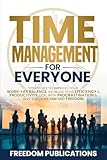
Overview: This comprehensive guide tackles time management as a holistic life skill rather than just a workplace productivity hack. It promises strategies to improve work-life balance while increasing efficiency, making it appealing to overwhelmed professionals and busy parents alike who need integrated solutions.
What Makes It Stand Out: The book’s inclusive title reflects its broad approach, covering procrastination, boundary-setting, and energy management alongside traditional scheduling techniques. It emphasizes sustainable productivity rather than grinding harder, addressing the modern crisis of burnout. The focus on “everyone” means it includes scenarios for different life situations, from students to executives to caregivers.
Value for Money: At $15.99, it sits in the mid-range for productivity books. It essentially combines content from multiple specialized books—time blocking, energy management, and work-life integration—saving you from buying three separate titles. The strategies require minimal additional investment in tools or apps, keeping implementation costs low.
Strengths and Weaknesses: Pros: Accessible language; covers diverse life contexts; practical exercises; addresses emotional aspects of time management. Cons: Lacks the deep expertise of single-focus books; some advice feels generic; fewer real-world case studies than premium alternatives; structure can feel scattered across too many topics.
Bottom Line: Ideal for readers seeking a one-stop introduction to time management principles. While not groundbreaking, it delivers solid, actionable advice for under $16. Choose this if you want breadth over depth and need help balancing professional and personal demands.
8. The Time Management Solution: 21 Proven Tactics To Increase Your Productivity, Reduce Your Stress, And Improve Your Work-Life Balance!

Overview: This tactical guide distills productivity wisdom into 21 specific tactics designed to reduce stress and improve work-life balance. Its numbered approach suggests a menu of options rather than a single prescriptive system, appealing to readers who want to cherry-pick strategies that fit their unique circumstances without overhauling their entire life.
What Makes It Stand Out: The “21 Proven Tactics” structure creates a quick-reference format perfect for busy readers. Each tactic stands independently, allowing immediate implementation without reading cover-to-cover. The book focuses on high-impact, low-effort changes and includes stress reduction as a core outcome, not just a byproduct, which distinguishes it from purely efficiency-focused guides.
Value for Money: At $11.99, this is the budget champion of the category. It delivers concrete strategies at a price point lower than most productivity apps’ monthly subscriptions. The tactics require no special equipment or software, making the total cost of implementation essentially zero while delivering immediate practical benefits.
Strengths and Weaknesses: Pros: Affordable; highly actionable; flexible implementation; quick wins possible; stress-management integration. Cons: Tactics may lack depth for complex organizational challenges; no unifying philosophy; quality varies between tactics; fewer scientific citations; can feel like a blog post compilation rather than cohesive book.
Bottom Line: Perfect for the cost-conscious buyer or as a supplementary resource. Don’t expect a transformative philosophy, but for $12, you’ll get at least 3-5 tactics that stick. Best for pragmatic readers who want immediate, no-frills solutions to specific time-management problems without theoretical baggage.
9. 15 Secrets Successful People Know About Time Management: The Productivity Habits of 7 Billionaires, 13 Olympic Athletes, 29 Straight-A Students, and 239 Entrepreneurs
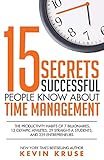
Overview: Kevin Kruse interviewed billionaires, Olympic athletes, and top students to extract their time management secrets. This research-driven approach grounds advice in real-world success stories, making abstract productivity concepts tangible and credible. The specificity of its sources adds authority that generic guides lack.
What Makes It Stand Out: The credibility factor is unmatched—who wouldn’t want to manage time like a billionaire? Each “secret” is backed by specific examples from high achievers, creating inspiring case studies. The book identifies common patterns across diverse fields, suggesting universal principles. It includes productivity hacks like the “1440 minutes” mindset that reframe how you value time.
Value for Money: At $23.50, it’s the priciest option, but you’re paying for access to elite insights that would take years to gather yourself. Comparable executive coaching costs thousands per hour. The premium is justified if the high-performer examples motivate you to act, though analytical readers might prefer data over anecdotes.
Strengths and Weaknesses: Pros: Highly motivating; diverse, credible examples; reveals counterintuitive strategies; includes specific tools used by elites. Cons: Anecdotal evidence may not suit analytical readers; success stories can feel unrelatable for average workers; some “secrets” are common knowledge repackaged; limited scientific backing compared to behavioral psychology books.
Bottom Line: Worth the investment if you need inspiration more than instruction. The high-achiever stories provide powerful social proof. However, if you prefer data-driven methods, opt for “Atomic Habits.” Best for ambitious professionals who learn through examples and aspire to elite performance levels.
10. Make Time: How to Focus on What Matters Every Day

Overview: From the creators of the Design Sprint, this book offers a refreshing approach to productivity centered on focusing on what matters daily. It challenges the “busy is good” culture with a simple framework for prioritizing meaningful work over endless tasks, specifically designed for the distraction-heavy modern workplace.
What Makes It Stand Out: The “Highlight” system—choosing one priority per day—is brilliantly simple and effective. It integrates seamlessly with digital tools without requiring tech asceticism. The authors’ Silicon Valley background brings startup agility to personal productivity, emphasizing experimentation and iteration over rigid systems, making it adaptable to changing circumstances.
Value for Money: At $12.87, it offers premium insights at a near-budget price. The framework saves hours weekly by eliminating low-value busywork. Comparable design-thinking productivity workshops cost hundreds. The companion website offers free templates and a community, extending the book’s value beyond its pages without additional cost.
Strengths and Weaknesses: Pros: Fresh, modern perspective; flexible framework; addresses digital distraction directly; includes “burnout” prevention tactics; visually engaging layout. Cons: May be too simplistic for complex corporate roles requiring multi-project management; Silicon Valley anecdotes won’t resonate with everyone; less comprehensive than encyclopedic alternatives; requires daily commitment that some may find rigid.
Bottom Line: An excellent choice for knowledge workers drowning in notifications and meetings. For under $13, you get a sustainable system that respects your energy and priorities. Perfect if you’re tired of traditional time management and want a human-centered approach that fits modern digital life without requiring complete disconnection.
Why Time Management Books Often Fail (and How to Spot the Exceptions)
Most time management books fail for the same reason diets fail: they prescribe a rigid system for a fluid, human problem. They offer beautiful theoretical frameworks that collapse under the weight of real-world interruptions, unpredictable energy levels, and the simple fact that life doesn’t care about your perfectly blocked calendar. The exceptions—the books that actually save time—share a common DNA: they treat time management as a personal experiment, not a universal law.
The Difference Between Theory and Actionable Systems
The first red flag is abstraction. Books heavy on philosophy but light on implementation create readers who can eloquently explain their time problems while remaining paralyzed by them. Actionable systems, by contrast, give you a starting point within the first chapter. They acknowledge that done is better than perfect, and that a flawed system you actually use beats a perfect system you ignore. Look for books that front-load practical exercises and treat theory as seasoning, not the main course.
Why Your Learning Style Matters More Than the Book’s Popularity
A book that works for your detail-oriented colleague might torpedo your creative flow. If you’re a visual learner, dense text without diagrams will gather dust. If you learn by doing, philosophical treatises on “the nature of time” will feel like homework. The most time-saving books align with how your brain processes information. Before buying, scan the table of contents. Does it have diagrams? Case studies? Step-by-step scripts? Bullet-point summaries? Match the format to your learning style, and you’ll cut your reading-to-implementation time in half.
Key Features That Define Time-Saving Time Management Books
Certain features separate the bookshelf trophies from the dog-eared tools you actually use. These aren’t aesthetic choices—they’re architectural decisions that determine whether a book becomes a reference manual or a paperweight.
Frameworks Over Fluff: What Makes a Methodology Sticky
Sticky frameworks have three qualities: they’re memorable, they’re flexible, and they compound over time. The book should teach you a mental model you can recall without checking notes—something like “capture, clarify, organize” or “important/urgent matrix.” If you can’t explain the core concept to a friend after one reading, it’s too complex to stick. The best frameworks are simple enough to remember but robust enough to adapt as your life changes.
The 80/20 Rule in Book Content: Identifying High-Value Information
Flip to a random chapter. If you can’t identify the single actionable takeaway within two minutes, the signal-to-noise ratio is too low. Time-saving books ruthlessly apply the 80/20 rule to their own content: 80% of the value comes from 20% of the pages. They use summaries, key point callouts, and end-of-chapter action steps to ensure you extract the gold without mining through anecdotes. Check for books that respect your time by making their structure scannable.
Worksheets, Templates, and Tools: The Difference Between Reading and Doing
A book without tools is a lecture. The most effective time management books include downloadable templates, fillable worksheets, or at minimum, clear instructions for creating your own systems. These artifacts force translation from concept to reality. When evaluating a book, ask: “Will I have a physical (or digital) output after reading this?” If the answer is no, you’re buying entertainment, not transformation.
Understanding Different Time Management Philosophies
Not all time management approaches are cut from the same cloth. Recognizing the underlying philosophy helps you avoid buying a book that solves problems you don’t have.
The Task-Centric Approach: Mastering Your To-Do List
These books operate on the principle that clarity and organization create freedom. They focus on capturing tasks, breaking down projects, and building reliable review systems. This philosophy works best for people whose stress comes from dropped balls and mental clutter. If your calendar looks clean but your mind feels chaotic, this is your lane. The key feature to look for is a robust methodology for weekly reviews and inbox zero principles.
The Energy Management Paradigm: Working With Your Biology
Time is finite, but energy is renewable. Books in this category argue that managing your ultradian rhythms, sleep, and mental bandwidth matters more than managing minutes. They teach you to schedule demanding work during peak energy windows and treat recovery as non-negotiable. Look for books that include self-assessment tools for identifying your chronotype and strategies for protecting high-energy periods from low-value interruptions.
The Systems Thinking Method: Building Automated Productivity
These are the “set it and forget it” playbooks. They focus on creating self-sustaining routines, automation, and decision-making frameworks that reduce cognitive load. The philosophy is simple: every decision you automate saves future-you time and willpower. Books in this category should offer templates for building personal SOPs (Standard Operating Procedures) and habit stacks that run on autopilot.
The Mindset-First Strategy: Changing How You Think About Time
Some books argue that your relationship with time is the real problem—not your tools. They dive into procrastination psychology, fear of failure, and the stories we tell ourselves about busyness. These are slower burns but create lasting change for people who’ve tried every app and still find themselves scrolling at midnight. Look for books that include reflection prompts and journaling exercises that surface your hidden time narratives.
How to Match a Book’s Approach to Your Professional Context
Your work environment dictates which time management strategies will stick. A freelancer’s “deep work” block looks very different from a middle manager’s.
For Entrepreneurs: Books That Scale With Your Business
Entrepreneurs need systems that evolve from solopreneur chaos to team delegation. The right books for this context emphasize priority-setting frameworks that survive context-switching and include methodologies for documenting processes others can execute. They should address the unique challenge of “working on the business” versus “working in the business” with practical separation strategies.
For Corporate Professionals: Navigating Bureaucracy and Meetings
If your calendar is a game of Tetris with other people’s priorities, you need books that teach diplomatic boundary-setting and meeting management. Look for frameworks that include “no” scripts, email triage protocols, and strategies for influencing team culture without authority. The best books for this audience treat organizational politics as a constraint to be managed, not ignored.
For Creative Workers: Protecting Deep Work and Flow States
Creatives don’t just manage time—they manage creative energy, which is easily shattered by context switching. Books for this audience should focus on batching communication, structuring “open” and “closed” modes of work, and creating environmental cues that trigger flow. The key feature is a methodology for protecting uninterrupted blocks while still meeting collaborative deadlines.
For Parents and Caregivers: Time Management Amidst Unpredictability
Rigid systems break when a child spikes a fever. Books for caregivers must embrace flexibility over strict scheduling. They should offer “minimum viable days,” contingency planning frameworks, and guilt-free strategies for lowering the bar when life demands it. Look for books that address mental load distribution and include partnership communication tools.
Red Flags: Warning Signs of Time-Wasting Time Management Books
Learning to spot a time-waster before you buy is the ultimate time-saving skill. These red flags indicate a book will cost more time than it saves.
The “Miracle Morning” Trap: Why One-Size-Fits-All Solutions Rarely Work
Be wary of books that prescribe a specific routine—wake at 5 AM, meditate, journal, exercise—as the universal key to productivity. These ignore chronotype diversity, family structures, and mental health realities. A time-saving book acknowledges that your optimal morning might look different and teaches you how to design it, not adopt someone else’s.
Overcomplication Bias: When More Steps Mean Less Action
If a book’s core method requires more than three steps to explain, it’s likely too complex to sustain. Overcomplication creates analysis paralysis. Time-saving books embrace elegant simplicity. They give you a starting point so simple it feels almost too basic because they know complexity is the enemy of execution. Watch out for books that require special apps, multiple notebooks, or elaborate coding systems—they’re selling a hobby, not a solution.
How to Actually Read Time Management Books to Save Time
The way you read matters as much as what you read. Passive consumption is the enemy; active implementation is the goal.
The Active Reading Framework: Reading With Implementation in Mind
Before reading, define your single biggest time leak. Then read specifically for solutions to that problem, ignoring everything else. Use the “teach-to-implement” method: after each chapter, write down the one action you’d teach someone else. This forces you to extract the core principle, not just the interesting story. Keep a running list of “tomorrow actions”—things you’ll implement within 24 hours.
The 24-Hour Rule: Why Immediate Application Beats Perfect Note-Taking
The half-life of reading-induced motivation is roughly 24 hours. If you don’t apply something within a day, you likely never will. Time-saving books are designed for this rule. They front-load quick wins and include “do this now” sections. Ignore the urge to finish the book before starting. Implementation is reading. The moment you encounter a useful idea, stop and apply it. A book you’ve partially implemented is infinitely more valuable than one you’ve perfectly highlighted but never used.
Building Your Personal Time Management Curriculum
No single book holds all the answers. The most time-savvy readers curate a personal curriculum, stacking methods and cycling through approaches as their life evolves.
Stacking Methods: How to Combine Different Approaches
The secret is to treat books as modular tools, not competing religions. You might use a task-centric system for work projects, an energy management approach for scheduling your day, and a systems-thinking method for household chores. The key is to create clear boundaries: “This system governs my work tasks, this one my personal energy.” Look for books that explicitly acknowledge their limitations and suggest complementary approaches.
The Review Cycle: When to Revisit and When to Move On
A time management book should have an expiration date on your active reading list. After three months of implementation, either the system is automated or it’s not working. Schedule a quarterly review: Is this still saving me time? If yes, it becomes reference material. If no, it gets donated without guilt. This cycle prevents you from becoming a productivity book collector and keeps you focused on tools that actively serve your current life stage.
Frequently Asked Questions
How do I know if a time management book will actually save me time before I buy it?
Check the table of contents for action-oriented chapter titles and scan the index for terms like “template,” “worksheet,” or “exercise.” Read the introduction—if the author promises a “revolutionary new philosophy” without mentioning practical application within the first few pages, it’s likely heavy on theory. Look for Amazon “Look Inside” previews that show chapter summaries or end-of-chapter action steps. The best litmus test: can you identify one specific tool you’ll use within 10 minutes of skimming?
Should I read multiple time management books or master one system first?
Master one system that addresses your current biggest pain point before stacking. Reading multiple books simultaneously creates conflicting advice and decision fatigue. Spend 90 days implementing one framework fully. Once it’s automated, identify the next friction point and select a book that specifically solves that problem. This sequential approach turns reading into a project with ROI, not a hobby.
What’s the biggest mistake people make when reading time management books?
Treating them as passive entertainment instead of active implementation manuals. The biggest mistake is finishing the book before doing anything. By the time you reach the last page, the initial motivation has evaporated. Another major error is perfect note-taking—color-coded highlights and elaborate summaries feel productive but delay real-world testing. Action creates clarity, not the other way around.
How long should it take to see time savings from a new system?
You should see micro-improvements within the first week—specifically, time saved on decision-making or reduced mental clutter. However, macro time savings (hours reclaimed per week) typically take 3-4 weeks of consistent implementation as you refine the system. If you haven’t noticed any improvement after a month, the system either doesn’t fit your context or you’re not implementing it fully. Time-saving books include early win metrics you can track.
Are digital or physical time management books more effective?
The format matters less than your interaction style. Physical books are better if you learn by writing in margins and need spatial memory cues. Digital books excel with searchable text and linked resources. The most important factor is whether the book offers downloadable tools. Many effective books provide digital templates regardless of purchase format, so check the publisher’s website. Choose the format you’ll actually carry and reference during implementation.
How do I adapt a book’s system to my unpredictable schedule?
Look for books that explicitly address “system maintenance during chaos” rather than assuming perfect conditions. The best ones include “minimum viable day” protocols—what to do when everything goes wrong. During implementation, identify the non-negotiable core of the system (usually 2-3 habits) and protect those while letting peripheral tactics flex. A system that can’t survive a bad week is a fragile system.
What if I’ve tried time management books before and nothing stuck?
You likely chose books that matched someone else’s problem, not yours. Get specific: is your issue prioritization, interruption, procrastination, or energy? Then select a book that targets that exact problem. Also, audit your implementation style—did you read cover-to-cover without doing? Try the “one-chapter, one-action” method. Past failure often means the book’s complexity exceeded your available willpower bandwidth. Start with a book whose core system can be explained in under two minutes.
Should I prioritize books with lots of scientific research or those with simple anecdotes?
Prioritize books that use research to inform action, not to impress. Dense scientific citations without clear “so what” statements are academic, not practical. Conversely, anecdote-only books lack the scaffolding to adapt the advice to your situation. The sweet spot is a book that references research briefly to justify a principle, then spends 80% of its words on application. Check the footnotes: are they explaining why, or just showing off?
How do I avoid turning time management into another time-consuming hobby?
Set a strict “implementation budget”—no more than 30 minutes per day on system maintenance. If a book’s method requires more setup time than it saves, it’s a hobby. Time management should be invisible, not all-consuming. The right book teaches you to build systems that run with minimal oversight. Track your time spent managing time; if it exceeds 5% of your week, you’ve fallen into the optimization trap.
Can time management books help with digital distraction and social media?
Only if they address the root cause, not just the symptom. Books that simply say “delete the apps” are useless because they ignore why you turn to them. Effective books include identity-based strategies—changing your self-concept from “someone who needs a break” to “someone who values deep focus.” Look for frameworks that include environmental design (friction for distractions, ease for desired actions) and identity-level reflection prompts, not just app-blocking tactics.